
“Should we be doing MEO, or SEO, or this AI search optimization we keep hearing about?” More and more local businesses ask us this, in exactly that order. They include shops, clinics, licensed professionals, and builders. They don’t have time to do everything, but they also don’t want to lose customers because they skipped one of them.
The confusion makes sense. A local business is no longer searched for in just one place. There’s Google Maps, regular Google Search, and questions put to AI tools like ChatGPT. Each one works differently, and each responds to different measures.
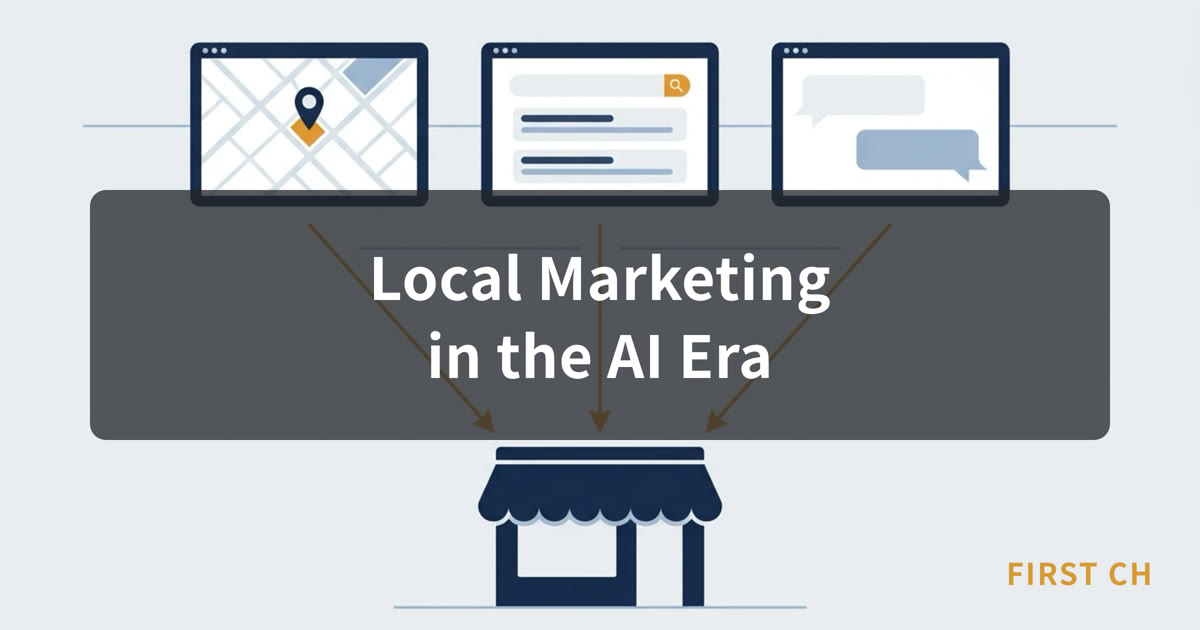
Local businesses are now searched for in three places: (1) Google Maps (MEO), (2) regular search (local SEO), and (3) AI search. But you don’t have to work on all three separately. For many types of business, the order of priority is Maps → regular search → AI search. All three draw on a common foundation: consistent business information, your Google Business Profile, and the basic information on your website. Get that foundation in place first, and one piece of work helps in all three places at once.
This article covers how the three search channels work and how they differ, which one your type of business should prioritize, and how to build a foundation that helps all three when your time is limited. We leave the step-by-step work for MEO and local SEO to separate articles. Here we focus on how to see the overall picture and where to start.
Local Businesses Are Now Found in Three Places
Let’s start with the big picture. Today, customers looking for a local business come in through one of these three entry points.
| Search channel | What the customer does | What appears | Name of the practice |
|---|---|---|---|
| (1) Google Maps | Searches “Shibuya chiropractor” and picks from the list on the map | Business Profile (name, rating, photos) | MEO |
| (2) Regular Google Search | Searches “Shibuya chiropractor stiff shoulders” and reads articles or websites | Websites and comparison articles | Local SEO |
| (3) AI search | Asks ChatGPT or a similar tool, “Which chiropractor in Shibuya is good for stiff shoulders?” | An answer written by the AI, with business names | GEO (generative engine optimization) |
Channels (1) and (2) have been around for a while. What’s new is (3). More and more people ask an AI directly for a “recommended place” and treat its answer as their shortlist. This is especially true of younger people and business users.
The key point is that the three channels don’t compete with each other. They reflect different situations the customer is in.
- People who want to decide where to go right now look at the map (1)
- People who want to compare and consider options search and read (2)
- People who want to describe their needs and narrow things down ask an AI (3)
How ready a customer is to buy also depends on which channel they found you through.

(1) Google Maps = MEO: The Main Battlefield for Walk-In Businesses
MEO means working to rank higher in Google Maps results. When someone searches “area name + type of business,” three listings appear alongside the map (the Local Pack). Whether you make it into those three spots has a big effect on how many customers walk in.
It suits businesses that customers choose based on proximity: restaurants, hair salons, chiropractors and bone-setting clinics, and medical practices such as dentists. In these businesses, customers mostly decide whether to go based on the rating, photos, and opening hours on the map, before they ever read your website.
According to what Google has made public, the main ranking factors are relevance, distance, and prominence. The parts you can influence yourself are how complete your Business Profile is and how you respond to reviews. We explain the specific steps in MEO Basics, so we skip them here.
Thinking of MEO as “just for the map” is becoming outdated. When an AI answers with local businesses, there are confirmed cases where Google Business Profile information (opening hours, ratings, attributes) is the source. Keeping your map listing in good shape also prepares the ground for (3) AI search.
(2) Regular Search = Local SEO: Effective for Businesses with Long Decision Times
Local SEO means working to get your website or its pages to rank high for searches like “area name + type of business + problem.”
It suits businesses that customers compare and consider before choosing: licensed professionals (tax accountants, judicial scriveners, administrative scriveners), builders and renovation companies, funeral services, buy-back shops, and so on. When the price is high, or the customer can’t afford a mistake, they don’t decide from the three map listings alone. They read and compare several websites. What matters is whether you have pages that get read at this stage.
The difference from MEO is that the competition happens on your own website. A Business Profile has fixed fields, but on your website you can publish anything that people still deciding want to know, such as “past projects,” “how we set our prices,” and “service area.” That freedom is what works for businesses with long decision times.
How to choose keywords and build pages is covered in A Practical Guide to Local SEO.

(3) AI Search: How Are Local Businesses “Recommended”?
The third way is asking ChatGPT, Gemini, or similar tools directly. Ask “Can you recommend a tax accountant in [city] who specializes in inheritance?” and the AI will answer with the names of businesses or offices.
As for what the AI bases its answer on, as far as can be confirmed today, there are two main routes.
- Real-time web search results. Many AI services run a search when they answer, then read and summarize the top-ranking pages, which means the pages that do well in (2)
- Map and review information. Answers sometimes include details such as opening hours and ratings that appear to come from Business Profiles
In other words, the closest understanding of the current reality is that AI search sits on top of (1) and (2). If you can be found on maps and in regular search, much of that carries over to AI search. On the other hand, there are currently almost no shortcuts that work “only” for AI search.
Which sources AI services use, and how they use them, is something each company changes often, and none of it is published as a fixed specification. This article is based on behavior that could be confirmed as of 2026. We are not at a stage where anyone can say for certain, “Do this, and AI will recommend you.” That’s exactly why we recommend spending your time on the foundation that every system draws on, rather than on specific techniques.
That said, there are things you can do that lean toward AI search. You can state your business, service area, and strengths clearly in text on your website, and use structured data to make your business information machine-readable. For details, see AI Search Optimization (GEO) Basics. For how the thinking differs from traditional SEO, see The Difference Between GEO and SEO.
Setting Priorities: Where Should Your Type of Business Start?
Now that you know what each channel is like, it’s time to split up your limited time. The deciding question is “How much research do customers do before deciding to visit or sign up?”
| Business type | Examples | Priority |
|---|---|---|
| Chosen on the spot, based on proximity or atmosphere | Restaurants, hair salons, chiropractors | Focus on (1) MEO. For (2), basic information only. For (3), build the foundation and wait for the effect to carry over |
| Chosen after comparison and consideration | Licensed professionals, builders, high-cost medical care | (2) Local SEO is the core. Work on (1) in parallel. Handle (3) as an extension of (2) |
| Mainly referrals and searches by name | Some licensed professionals, B2B | Minimum upkeep for (1) and (2). Top priority is making sure the right information appears when someone searches your name |
What every type has in common is that (3) AI search should not come first as a standalone effort. As explained above, AI search draws on the information in (1) and (2). If you work only on AI search before the foundation and (1) and (2) are in place, there’s no source information for it to draw on. It’s fine for it to come last. But “last” doesn’t mean “unnecessary.” We expect it to become a growing source of name searches that start with a question to an AI, especially for businesses with long decision times.
Many of you probably get sales calls offering to “handle your MEO for a monthly fee.” We won’t discuss whether to hire such a service here. But the foundation described in this article (keeping your profile up to date and your information consistent) is work you can manage in-house. If you do outsource it, always make sure ownership of the account stays with your business.
The Foundation That Works for All Three: Get These Three Things Right First
Before working on any single channel, there’s a shared foundation that all three draw on. If you’re short on time, you can stop after this section and still see results.
- Consistent NAP information: Make sure your business Name, Address, and Phone number are written exactly the same way on your website, your Business Profile, and every listing site. Even small variations, such as mixing “1-chome 2-3” and “1-2-3,” may look like different information to a machine
- A well-maintained Google Business Profile: Fill in your opening hours, categories, services, and photos, and update them the same day anything changes. It is the core of (1) and also a source for (3)
- A basic information page on your website: State what you do, your service area, how you set prices, and how to get there, in text rather than images. It is where (2) sends people, and it’s in a form AI can read and quote
These three are “the foundation” because every one of (1), (2), and (3) ultimately reads the information written here when it displays results or answers. One round of work helps all three channels at once, which makes it the best use of your time.
In particular, how your Business Profile and website relate to each other, meaning what to put where and how to connect them, is explained in detail in When to Use Your Google Business Profile vs. Your Website.

Frequently Asked Questions
- Is there any point in doing AI search optimization first?
-
We don’t recommend it at this point. When an AI answers with local businesses, it draws on existing sources such as regular search results and Business Profiles. If you work only on AI search before that source information is in place, there’s nothing for it to draw on. Doing the foundation first, then MEO and local SEO, then AI search, is in the end also the fastest route to AI search.
- Our review rating is low. Should we deal with that first?
-
Before worrying about the rating number itself, start by not leaving reviews unanswered. A sincere reply to a negative review explains things to the next customer who reads it. Also, paying someone to remove negative reviews or buying fake reviews is not only against Google’s policies; you’d lose far too much if it came to light.
- We don’t have time for all three. If we can do only one thing, what should it be?
-
Keep your Google Business Profile up to date. It is the core of (1) maps, a source for (3) AI search, and it also appears in (2) search results. That makes it the only task that touches all three channels at once. Just filling in your opening hours, categories, photos, and services and reviewing them once a month will put you ahead of doing nothing.
Summary
Local businesses are now searched for in three places, but that doesn’t mean three times the work.
- (1) Maps (MEO) is the main battlefield for businesses chosen on the spot, and (2) regular search (local SEO) for businesses chosen after consideration
- (3) AI search sits on top of the information in (1) and (2), and for now there’s no separate shortcut
- The foundation of consistent NAP information, your Business Profile, and basic website information helps all three channels at once
- Set priorities based on how much customers research before choosing a business like yours
Not sure which channel your business has the most room to grow in, or whether AI can currently draw on your profile and website? Send us your current URLs. We’ll show you how you appear in each of the three search channels and which areas to fix first.







