
“A sales rep told us we need GEO. Is that something separate from SEO?”
As AI search spreads, we hear this question more often. When a new acronym appears, the first reaction is often worry that everything you’ve done so far will go to waste. The short answer is that you have little reason to worry.
GEO and SEO share 80% of the work. Technical groundwork, accurate information, and recognition from third parties help with both. The difference is in the remaining 20%, mainly “how you write the body text” and “how you communicate with machines.” You don’t need to drop SEO and switch to GEO.
This article separates the two at a practical level of detail. It sorts out what to start now, what can wait, and what you don’t need to spend money on.
GEO and SEO have different destinations but travel the same road
Definitions: SEO aims for rankings, GEO aims for citations
SEO (Search Engine Optimization) is the work of ranking high in the list of search results. GEO (Generative Engine Optimization) is the work of getting your company cited as a source inside the answers that AI generates.
The destinations differ, but the roads that lead to them largely overlap. The reason is an underlying fact: much of today’s AI search uses search engine systems to find web pages when it builds an answer. A page that search can’t find is also a page AI can’t find.
Comparison table: what’s the same and what’s different
| Aspect | SEO | GEO |
|---|---|---|
| Goal | Rank high in search results | Be cited in AI answers |
| How results show up | Rankings and clicks | Whether you are cited, and growth in branded searches |
| Shared foundation | Page speed, mobile support, internal structure, backlinks | Same as SEO (works almost as is) |
| Unique elements | Keyword planning for titles and headings | Conclusion first, definition sentences, figures and sources |
What the “80% in common” includes
Specifically, the following elements help with both in the same way.
- Your site is indexed correctly (nothing is blocking crawling)
- Page speed and smartphone support
- Information is specific, with evidence shown
- Company information is clear, and the operator can be identified
- Other websites mention and link to you
There are almost no new technical elements. The practical conclusion is that a company that hasn’t covered the basics of SEO cannot do GEO first. We cover the basics of SEO itself in “What Is SEO for Your Website? An Easy Guide for Beginners.”
The difference: text written for humans to read, or answers handed to machines
The remaining 20%, the part unique to GEO, comes down to three things.
Difference 1: How the body text is ordered
SEO articles have long used a structure that first wins the reader’s empathy in the introduction and then moves toward the conclusion. This made sense for increasing time on page, but it is a disadvantage when it comes to being cited by AI.
What AI looks for is a complete answer it can use as is. Pages that state their point clearly at the very beginning are more likely to be cited.
Difference 2: Whether there are definition sentences, figures, and sources
An academic study on generative engine optimization (presented at KDD 2024) reported that changes such as adding statistics to the body text, including quotations, and clearly stating sources improved visibility in AI answers by up to 40% (Source: GEO: Generative Engine Optimization).
Instead of writing “This is common knowledge in the industry,” write “A survey found X% (source link).” That difference affects how often you are cited.
Difference 3: There are now more crawlers to manage
Until now, the crawlers you had to think about were mainly Google’s. Now crawlers from various AI companies have joined them. Their roles are split between training and search/retrieval, so blocking all of them across the board also costs you chances to be cited.
It’s understandable to want to refuse use of your content for training. However, if you also block the crawlers used for search and retrieval, you won’t appear in AI search. Note that for Google’s training token (Google-Extended), the official documentation clearly states that it does not affect inclusion or ranking in Google Search (Source: Google Search Central).
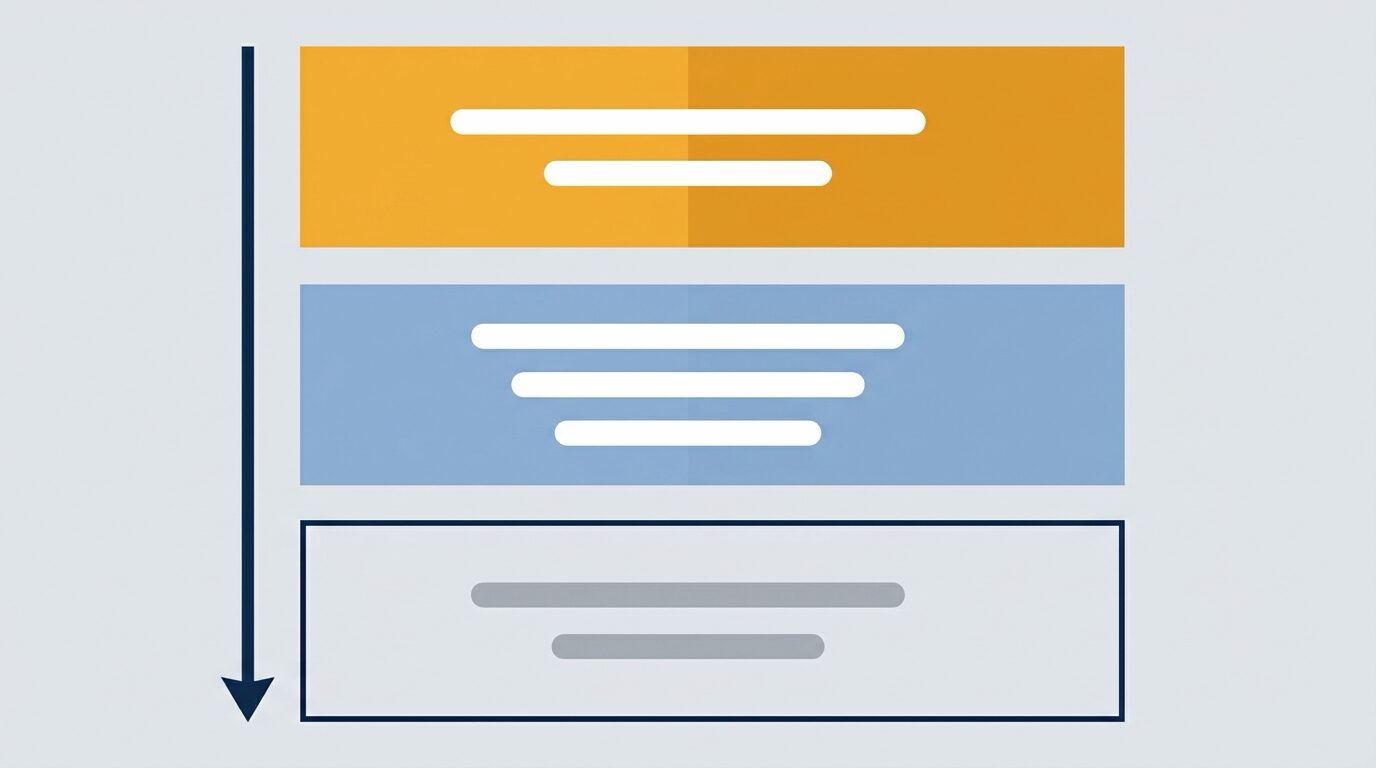
Priorities: Do, Postpone, Skip
To make decisions with a limited budget and limited time, we sort tasks into three groups.
Do it now (free to low cost)
Add a conclusion paragraph of 2 to 4 sentences at the top of your service, pricing, and company pages. In most cases, rearranging existing text is enough.
“Extensive track record” → “X projects completed,” “Fast turnaround” → “As little as X weeks.” AI does not use vague expressions as evidence.
Write the questions that actually come up in sales meetings as question-and-answer pairs. This helps with both GEO and SEO, and you can also use it as sales material.
Can wait (effective, but not urgent)
- Expanding structured data: It can be expected to help, but it requires implementation. It’s efficient to handle it together during a site redesign or as part of maintenance. For details, see “What Is Structured Data (Schema)? Benefits and How to Set It Up“
- Adding llms.txt: At present, the major AI search crawlers rarely refer to this file. The setup cost is small, so think of it as something to add if you have time to spare
- Adopting tools that automatically monitor AI citations: Measurement methods haven’t been established yet, and we don’t think it’s time to pay a monthly fee for them
No need to do for now (cost-effectiveness is unclear)
- Expensive “GEO packages”: If you receive a proposal in the range of several hundred thousand yen, always confirm what the deliverables are. “Getting cited by AI” is by nature something that can’t be guaranteed, so a contract should be based on the content of the implementation work
- Mass-producing articles for AI: Adding thin articles won’t get you cited by AI, and it lowers the evaluation of your entire site
- Giving instructions to AI through hidden text: This violates search engine guidelines, and the risk isn’t worth the benefit
Web制作・システム開発は
First CHにお任せください
「こんなWebサイトが欲しい」「このシステムは実現できる?」——
現役エンジニアが直接お話を伺い、最適な進め方をご提案します。
「まだ構想段階」「費用感だけ知りたい」というご相談も歓迎です。
Three questions tell you whether a proposal is reasonable
Any new field brings proposals with no clear market rate. Even without specialist knowledge, you can judge a proposal by asking these three questions.
Question 1: “What are the deliverables?”
“We’ll get you cited by AI” is not a deliverable. Whether to cite you is up to the AI, and no one can guarantee it.
A sound proposal should list work you can verify as a deliverable, such as “implement X types of structured data,” “rewrite the body text of X key pages,” or “configure robots.txt.” If an estimate doesn’t come with a list of tasks, you can’t check whether the price is reasonable.
Question 2: “Why in that order?”
If a proposal skips the measures you can do for free (placing conclusions, building out the FAQ, adding numbers) and starts right away with technical implementation, ask why.
Depending on the state of the site, technical implementation sometimes does come first. If they can explain why, there’s no problem. If they can’t answer, they may simply be listing the menu items with the highest rates first.
Question 3: “How will results be reported?”
Measurement methods in this field are not yet established. So if someone promises definitive reports such as “X% increase in citation rate,” you should check the basis for that claim.
A realistic report covers three things: “what was implemented,” “a record of the results of actually asking AI questions,” and “trends in branded searches and traffic.”
Base the contract on “work,” not “results.” The same principle applies to SEO, and it matches how contracts that guarantee rankings came to be seen as a problem. GEO is even harder to measure, which makes this principle all the more useful.
Why “add on” rather than “switch”
Search isn’t going away
With the spread of AI Overviews, click-through rates from search results have in fact dropped. In a study of 300,000 keywords published in February 2026 by an overseas SEO tool company, organic clicks fell by about 37.8% in the Japanese market and by about 58% globally (Source: Survey on the zero-click impact of AI Overviews).
Clicks have decreased, but they haven’t gone to zero. More importantly, to be cited by AI, a page ultimately has to be well evaluated by search. If you stop doing SEO, the foundation for GEO collapses too.
What the numbers mean changes
On the other hand, the metrics you should watch do change. If you only track clicks, your numbers will look like they’re falling even when your measures are correct.
| Metric | Until now | Going forward |
|---|---|---|
| Primary metrics | Sessions and rankings | Inquiries and branded searches |
| Secondary metrics | Click-through rate | Traffic from AI and whether you are cited |
People who arrive via AI have already received an explanation from the AI before they come, so each visit tends to be of higher quality. If visits drop but inquiries don’t, that isn’t a decline.
Frequently asked questions
- Should we switch our SEO contract to a GEO contract?
-
There’s no need to switch. Because 80% of the work is shared, the realistic approach is to continue your existing measures and add a writing pattern of “conclusion first, definition sentences, figures and sources.” Be wary of proposals where only the contract name changes and the price goes up.
- How long does it take for GEO to show results?
-
It takes weeks to months, because AI needs time to re-fetch pages and reflect them in its evaluation. On top of that, measurement methods are still immature, so this is an area where results are hard to see as clear numbers like “our ranking went up.”
- Is it worthwhile for small businesses?
-
Yes. In fact, the smaller the company, the more room it has to be cited for specific questions that include a region or industry name. You have a better chance with narrow, specific questions than with the general keywords that large companies already dominate.
- I don’t know where to start.
-
Start with “put a conclusion at the top of key pages.” It costs nothing, and it helps with AI, with SEO, and for the people who read the page. We’ve summarized the specific steps in “How to Build a Site That Gets Cited by AI Search.”
Summary: 20% is new, the rest is the same as before
- GEO and SEO share 80% of the work. Think of it as adding on, not switching
- The differences are the writing pattern of “conclusion first, definition sentences, figures and sources” and how AI crawlers are handled
- Finish the three free tasks first (place conclusions, replace vague wording with numbers, build out your FAQ)
- For expensive GEO packages, confirm what the deliverables are before signing
- Look beyond clicks to inquiries and branded searches
We use our own website as a test bed and are testing things like structured data and crawler settings. You’re welcome to consult us even if you only want to know whether a proposal you’ve received is reasonable. Feel free to contact us.
Web制作・システム開発は
First CHにお任せください
「こんなWebサイトが欲しい」「このシステムは実現できる?」——
現役エンジニアが直接お話を伺い、最適な進め方をご提案します。
「まだ構想段階」「費用感だけ知りたい」というご相談も歓迎です。







