
“A customer told us, ‘I looked you up on ChatGPT and your company didn’t come up.'”
We have been getting more requests like this lately. Until now, search meant Google, and the goal was to climb the rankings. But what is happening now is not a race to “rank higher.” It is a different game: getting “cited inside the AI’s answer”.
AI search optimization (GEO) means getting your website cited as a source in the answers that AI generates. There are no special tricks, and the foundation is the same as traditional SEO. On top of that, what works is a writing pattern: state the conclusion first, give a one-sentence definition, and back up figures with sources.
This article draws on our hands-on work building websites to give an honest explanation of how AI chooses which sources to cite, what small businesses can start doing today, and how to measure the results.
AI Search Optimization (GEO) Means Getting Cited in AI Answers
Definition: GEO = optimizing to be chosen as a source in generative AI answers
GEO (Generative Engine Optimization) means optimizing your website so that when generative AI such as ChatGPT or Google’s AI Overviews writes an answer, it cites or refers to your site as a source.
Traditional SEO aimed to “appear near the top of the search results list.” GEO aims to “have your company appear as a supporting source inside the text the AI writes.” Instead of 10 links, the user sees a single answer. If you are not included in that answer, it is as if you do not exist.
Why this has become a problem now
The reason is simple: fewer people are actually clicking on search results.
A study published in February 2026 by an overseas SEO tool company compared December 2023 with December 2025 across 300,000 keywords. It reported that the appearance of AI Overviews reduced organic clicks in the Japanese market by about 37.8%, and by about 58% globally (Source: Study on the zero-click impact of AI Overviews).
User behavior is also changing fast. According to the Ministry of Internal Affairs and Communications’ White Paper on Information and Communications (Reiwa 8 / 2026 edition), the share of individuals in Japan who have used generative AI is 58.8%. That is double the 26.7% from the previous survey just one year earlier (Source: MIC White Paper on Information and Communications).
What is really happening is not that search rankings have dropped. It is that pages get fewer clicks even at the same ranking. Working to earn rankings is still worthwhile. The order is to keep doing that, then add a “writing style that gets cited” on top.
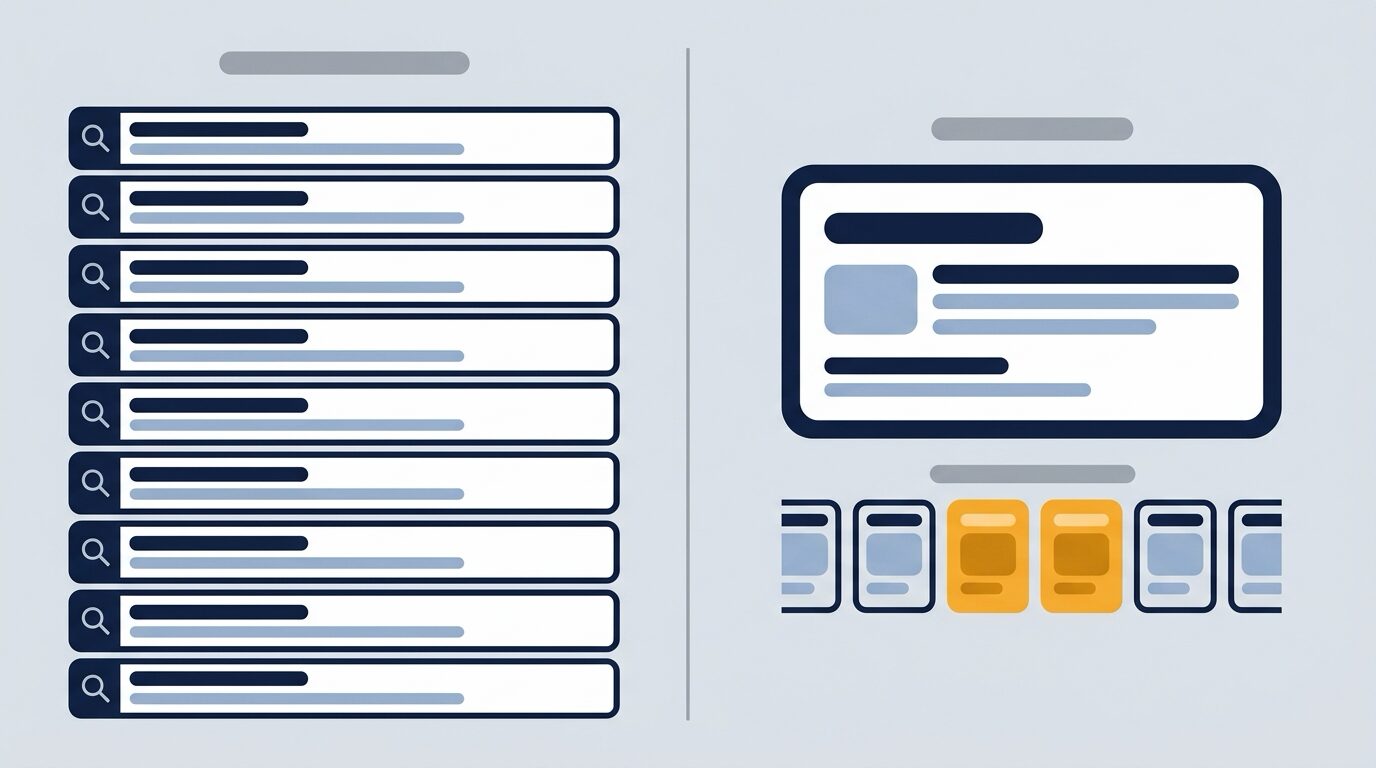
AI Cites Information That Is in the Search Index
If you misunderstand this point, your efforts will miss the mark. Generative AI builds its answers in two broad ways.
Route 1: Training data (knowledge it has already read)
Here the AI answers from the huge amount of text it was trained on, up to the time of training. Getting your company into this data is beyond what a single business can control. It is not something to target.
Route 2: Real-time search (looking things up for each answer)
This is now the main approach in AI search. When the AI receives a question, it uses a search engine or crawler to fetch web pages on the spot and builds its answer based on their content. This is why source links appear below the answer.
In other words, to be on the cited side, you need two things: “AI can find you” and “your content is easy to read and cite”. The first rests on almost the same foundation as traditional SEO (getting indexed and getting evaluated).
AI crawlers come in two types: “training” and “search”
The robots that visit your site also have different roles. If you confuse them and block them all, you also shut off the chance of being cited.
| Type | Role | Common crawler names |
|---|---|---|
| Training | Collecting data to train AI models | GPTBot, ClaudeBot, Google-Extended |
| Search / retrieval | Fetching pages in real time to answer questions | OAI-SearchBot, Claude-SearchBot, PerplexityBot |
If your policy is “we don’t want to be used for training, but we do want to be cited in AI search,” you can set robots.txt to block only the training crawlers and allow the search/retrieval ones.
If you block all AI-related crawlers as a security measure, you are also removed from what AI search can cite. Google’s official documentation also states clearly that its training token (Google-Extended) does not affect inclusion or ranking in Google Search (Source: Google Search Central). Do not copy a setting without checking what it means.
Whether You Get Cited Depends on the Shape of Your Answer
Even with the same content, some ways of writing are more likely to be cited than others. This is not just a hunch. Research has tested it.
An academic study on generative engine optimization (a paper presented at KDD 2024) reported that changing how content is written increased visibility in generative AI answers by up to 40%. The methods with the clearest effect were “adding statistics,” “adding quotations,” and “citing sources” (Source: GEO: Generative Engine Optimization).
Pattern 1: State the conclusion first
AI does not necessarily read a whole page carefully and summarize it the way a person would. A page that states its conclusion clearly at the start is easy to cite as is, and that simple fact gives it an advantage.
This means the order often preferred in Japanese writing, “background first, then the problem, and the conclusion last,” does not work well with AI search.
Pattern 2: Give a one-sentence definition
Whether the text contains a sentence in the form “X is Y” changes how likely the page is to be cited. When AI answers a question like “What is X?”, it is looking for a complete sentence it can use as is.
Put one definition sentence, stripped of extra modifiers, right after the heading. That alone is enough.
Pattern 3: Pair figures with sources
Instead of “many companies have adopted it,” write “58.8% in a survey (FY2025).” Then always link to where that figure came from. These are exactly the two points the study above found to be effective.
Citing sources is an AI tactic, and it is also a matter of honesty toward the people who read your page.
Web制作・システム開発は
First CHにお任せください
「こんなWebサイトが欲しい」「このシステムは実現できる?」——
現役エンジニアが直接お話を伺い、最適な進め方をご提案します。
「まだ構想段階」「費用感だけ知りたい」というご相談も歓迎です。
Seven Things Small Businesses Should Do First
These are listed from highest to lowest priority. You can start the first three today at no cost.
At the top of your service pages, company profile, and main articles, add a short paragraph of 2 to 4 sentences that states the conclusion clearly. You are rewriting existing pages, so you do not need to build anything new.
Write down the questions you actually get asked in sales conversations, as question-and-answer pairs. AI is looking for “question and answer pairs,” and an FAQ is exactly that format.
Make vague information specific: address, year founded, service area, price range, number of projects, and so on. AI is less likely to use vague statements as a basis for its answers.
Describe your company information, services, and FAQ in a format that machines will not misread. How to implement it is explained in a related article.
Open robots.txt, decide how to handle training and search crawlers, and state it clearly. If nothing is written there, all crawlers are allowed by default.
AI does not rely only on what one site says about itself. It helps to increase the places where your name appears on outside sites, such as business partners’ sites, industry media, and local organizations.
Citing outdated information lowers the quality of an answer, so freshness is a factor in the decision. Make it a practice to show the update date whenever you update a page.
Item 4, structured data, requires technical implementation, but it is a high-return measure for conveying your information to AI accurately. For details, see “What Is Structured Data (Schema)? Benefits and How to Set It Up.”
Item 6 is the biggest weak point for many companies, because it cannot be done entirely within your own site. To be honest about this field, optimizing your own site alone will not get you cited.
Three Things Not to Do
- Embedding hidden text aimed at AI: Planting instructions to AI or self-recommendations in text that people cannot see violates search engine guidelines, and the risk if it is discovered far outweighs any benefit
- Filling your site with mass-produced AI articles: Adding articles with no substance will not get you cited by AI. If anything, it lowers the evaluation of your whole site
- Making a large investment before seeing results: GEO is a field where methods for measuring results are still immature. Before jumping on a “GEO package” costing several hundred thousand yen, finish everything you can do for free first
Start Measuring Results by “Asking AI Directly”
At present, there is no standard way to measure AI search citations accurately and automatically. That said, in practice these three methods are enough to get a good sense of the trend.
1. Actually ask AI questions (once a month)
Ask several AI services questions such as “What are some recommended companies for (industry) in (area)?” or “What kind of company is (your company name)?” and record the results. Just noting three points, whether you were cited, whether the content was accurate, and whether competitors came up, is enough to see changes.
2. Check traffic from AI in your analytics
AI service domains now appear among the referral sources in GA4. The numbers are not large, but people who come via AI arrive having already narrowed down their options, so they tend to convert to inquiries at a higher rate. For how to pinpoint why your traffic isn’t growing, also see “5 Reasons Your Website Isn’t Attracting Customers and How to Fix Them.”
3. Track branded searches
More people learn a company’s name through AI and then search for it on Google. Tracking how often your company name is searched in Search Console reveals the indirect effect.
Frequently Asked Questions
- If I do GEO, will AI start citing me right away?
-
No. It takes time for AI to re-fetch your site and reflect it in its evaluation. Think in terms of weeks to months. Also, if your site is not properly indexed by search engines in the first place, you need to solve that earlier step first.
- If I’m already doing SEO, do I still need GEO?
-
About 80% of the foundation is shared, so sites doing SEO properly start from an advantage. However, writing patterns such as “state the conclusion first,” “include a definition sentence,” and “pair figures with sources” are often overlooked in traditional SEO articles, and this is where the difference lies.
- I heard that placing a file called llms.txt will get me cited by AI. Is that true?
-
For now, its effect is limited. In June 2025, a Google Search representative stated clearly that “no AI system currently uses llms.txt,” and there is research showing that major AI search crawlers rarely fetch this file. The cost of adding it is small, so it does no harm to have one, but if someone charges you for it on this basis, ask them for evidence.
- Even after taking measures, AI gives wrong answers about my company. What should I do?
-
Much misinformation comes from the correct information not being clearly stated on the official website. Rewrite your company profile, services, service area, and similar information in specific terms, without vague wording. Where AI cannot find a basis, it fills the gap by guessing from other sources.
- Should I pay an outside company to do this?
-
Items 1 to 3 in this article (stating the conclusion first, building out the FAQ, and making information specific) can be handled in-house. Outsourcing is worth considering for technical areas such as implementing structured data or reviewing site structure. The healthy approach is to order this as implementation work, not as a contract that guarantees “getting cited.”
Summary: Not a Clever Trick, Just Writing Accurately
- GEO means getting your site cited as a source in AI answers
- The main approach in AI search is to “look things up on the spot and answer.” A solid SEO foundation is a direct prerequisite
- How likely you are to be cited depends on how you write. The three things that work are conclusion first, definition sentences, and figures with sources
- Finish what you can do for free first (conclusion blocks, FAQ, and specific information)
- Measuring results is still developing. Start by asking AI once a month and recording the results
We test GEO measures on our own site first, including structured data and crawler settings, to verify what works. We welcome inquiries at any stage, even “How does our site look in AI search?” Feel free to contact us.
Web制作・システム開発は
First CHにお任せください
「こんなWebサイトが欲しい」「このシステムは実現できる?」——
現役エンジニアが直接お話を伺い、最適な進め方をご提案します。
「まだ構想段階」「費用感だけ知りたい」というご相談も歓迎です。







