
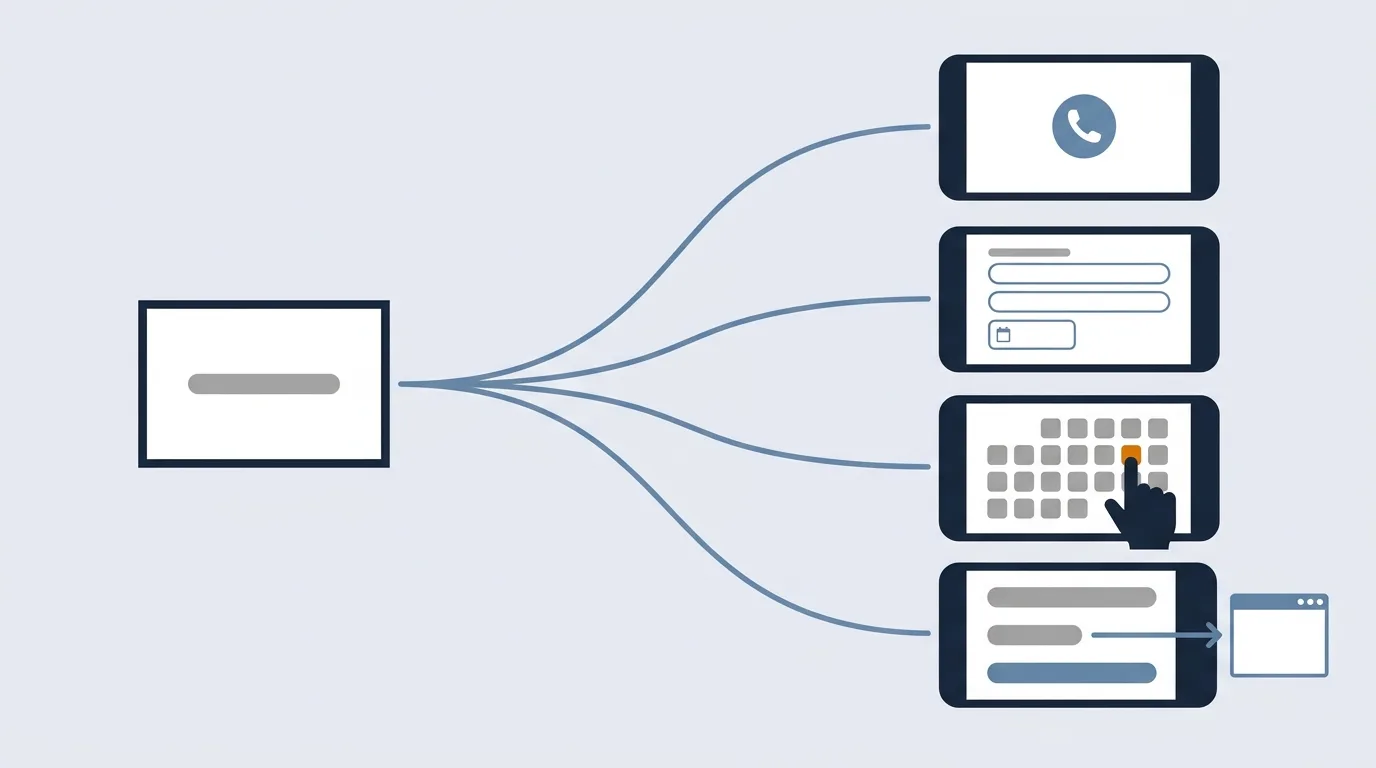
If your quote request says “we want a booking feature,” a web developer could read it in several ways. It could mean anything from a button that calls your phone number to a system where customers pick an open slot and confirm it themselves. Each reading takes a different amount of work. So either each company quotes for something different, or they send you questions before they reply.
This article starts with a table of 7 common terms and how to rephrase them, followed by email templates that use the rephrased lines for a new site and a redesign. After that, it covers real cases where developers asked for clarification and shows how to write about things you have not decided yet.
“Booking feature,” “social media integration,” “update it ourselves,” “number of pages,” “blog,” “contact form,” and “migration from the existing site” are terms that developers can read in two or more ways. When you use them, add what it covers, who handles it, and the quantity or frequency, as far as each applies. For example, instead of “booking feature,” write something like “Customers book a trial lesson by choosing an open slot on a calendar and confirming it. Staff enter the open slots.” For things you have not decided yet, write “undecided” or “we’d like to discuss this,” and keep them separate from what you have decided.
Writing this way reduces three problems: different companies reading the same term in different ways, back-and-forth questions before they reply, and finding out after signing that the result is “not what we expected.” It does not remove the need for questions entirely. Price differences caused by each company’s rates and proposals (structure, design, tools) will remain, and so will extra work if your requirements change after you send the request.
Why quotes differ in price is covered in Getting Multiple Website Quotes: How Many Companies to Ask and Why the Prices Differ. How to read a quote once you receive it is covered in How to Read a Website Quote: 5 Points to Check So You Don’t Lose Out. This article covers the step before both of those: writing the request.
Rephrasing Table: 7 Terms and One Line That Reduces Follow-Up Questions
How each term is read, what developers ask, and how to write it in one line
Developers send follow-up questions because a single term can cover several options that take very different amounts of work. If they quote for the cheaper option, extra charges come later. If they quote for the more expensive one, their price looks high next to other quotes. So they cannot simply choose one on your behalf.
The table below lists, for each of the 7 terms, how developers might read it, what they will ask, and a one-line version you can use as is. The details in the one-line examples are fictional. Adapt them to your own situation.
| Term | How developers might read it | What developers will ask | Example one-line version |
|---|---|---|---|
| Booking feature | Take requests by phone or form / confirm from open slots / link to an external booking service | What is booked, who manages it, and how it is confirmed. Is there advance payment? | Customers book a trial lesson (60 min) by choosing an open slot on a calendar and confirming it. Two staff members enter the open slots |
| Social media integration | Icon links / automatically show latest posts / automatically post site updates to social media | Which platforms? Links only, or show posts? | Automatically show the latest Instagram posts on the home page; place only a link for X |
| Update it ourselves | News only / text and photos on all pages / adding new pages too | Which parts, who, and how often | One person in general affairs adds news and project case studies about twice a month. Other pages are updated by request |
| Number of pages | Number of screens / number of menu items / count including posts | Do blog posts count? Are any sections combined into one long scrolling page? | 5 static pages (Home, Company Profile, Services, Careers, Contact) + news list and post detail. 〔○〕 posts loaded at launch |
| Blog | Diary-style posts / a news section / ongoing posts to attract visitors from search | Who writes? How many categories? Will current posts be moved? | One news list. We write the posts ourselves, with two categories: “News” and “Case Studies” |
| Contact form | Name, email, and message only / with quote fields or attachments / auto-reply and notification recipients | Fields, notification addresses, and whether there is an auto-reply | Five fields: company name, name, email, phone, message. Notifications go to two addresses (the main company address and the person in charge), with an auto-reply |
| Migration from the existing site | Move text and photos only / move all posts too / keep or redirect URLs / move domain and email too | What will be moved? How many posts? Will you keep the domain and server? | Reuse the text and photos from the current site. Also move about 40 news posts. Keep the current domain |
How much you can update yourself depends on how the site is built. Deciding which parts should be editable is covered in How Much of Your Website Can You Edit Yourself?, keeping post URLs during migration in URL Migration That Helps Protect Search Rankings During a Redesign, and building forms in How to Create a Contact Form.
Write “number of pages” with static pages and posts listed separately
The “number of pages” row lists static pages separately from the sections where posts keep growing because the two involve different kinds of work. It does not mean the posts section involves no work. Building the screens (templates) for the post list, post detail, and category lists for news or case studies can be part of the quote, and so can loading the posts that go live at launch (initial posts). In your request, list these on a separate line, for example: “5 static pages + news list and post detail. 〔○〕 initial posts.”
What the one line adds
The right column of the table fills in the information each term is missing. The added information falls into three main types:
- What it covers: what gets booked, which social media is shown, which section is updated, which posts are moved, and so on
- Who handles it: whether customers operate it, and who in your company updates it
- Quantity or frequency: number of pages, number of posts, how often, number of recipients
Not every term needs all three. For a contact form, it is the fields and notification recipients; for a migration, it is what gets moved and how many posts. Add only what applies to that term.
Quote Request Email Templates You Can Use As Is
For building a new site
These templates use the phrasing from the table. Replace the parts in 〔 〕 with details from your own situation.

Subject: Request for a quote for a new corporate website (〔Company name〕)
Dear 〔Web development company name〕,
My name is 〔Name〕 from 〔Company name〕. We would like to build a new website for our company and are requesting a quote.
■ Purpose: 〔Let business partners check our company overview, and receive job applications〕
■ Pages: 〔5〕 static pages (〔Home, Company Profile, Services, Careers, Contact〕) + news list and post detail. 〔○〕 posts loaded at launch
■ Parts we will update ourselves: 〔One person in general affairs〕 will add news about 〔twice a month〕. Other pages will be updated by request
■ Social media: 〔Place only an icon link for Instagram〕
■ Contact form: Fields are 〔company name, name, email, phone, message〕. Notifications to 〔2〕 addresses, with an auto-reply
■ Text and photos: We will provide the text. For photos, 〔we would like you to take some of them〕
■ Undecided / to discuss: 〔Whether to accept in-store bookings. If we do, please explain the differences between the methods. Advance payment at booking is 〔undecided〕〕
■ Preferred launch: Around 〔March 2027〕
■ Budget: We are thinking of up to 〔¥◯◯0,000〕 (we want to prioritize what is necessary within that range)
■ Quote breakdown: We would like the initial build cost, external service fees, and post-launch maintenance fees listed separately
■ Preferred quote reply date: We would appreciate it by around 〔Month Day〕
If you need any other information for the quote, please let us know.
〔Signature〕
For rebuilding your current site (redesign)
For a redesign, add what you will move and what you will keep.
Subject: Request for a quote for a website redesign (〔Company name〕)
Dear 〔Web development company name〕,
My name is 〔Name〕 from 〔Company name〕. We are requesting a quote for redesigning our company website.
■ Current site: 〔URL〕 (built around 〔year〕. Currently, 〔our previous web developer〕 handles updates)
■ Reason for the redesign: 〔Hard to view on smartphones, and we cannot update the news ourselves〕
■ What to move: We will reuse the current text and photos. We would also like to move about 〔40〕 news posts. For post URLs, 〔we would like to keep them if possible〕
■ What to keep: The domain stays as is. For the server, 〔we would like to discuss whether to keep it or move it〕. Our company email 〔uses the same domain〕
■ Pages: 〔6〕 static pages (adding a new 〔Careers〕 page) + list and post detail for news and 〔project case studies〕
■ Parts we will update ourselves: 〔One person in charge〕 will add news and 〔project case studies〕
■ Booking: 〔We want customers to book store visits by choosing an open slot on a calendar and confirming it. Two staff members will enter the open slots〕. Advance payment: 〔none / yes / undecided〕
■ Undecided / to discuss: 〔We are checking whether we can log in to the current site’s admin screen〕
■ Preferred launch: Around 〔April 2027〕
■ Budget: We are thinking of up to 〔¥◯◯0,000〕
■ Quote breakdown: We would like the initial build cost, external service fees (such as a booking service), and post-launch maintenance fees listed separately
■ Preferred quote reply date: We would appreciate it by around 〔Month Day〕
I have attached screenshots of the current site and a list of posts. If you need any other information, please let us know.
〔Signature〕
If your company email runs on the same domain, say so in the request. That makes it less likely that email will be left out of the rebuild work. For how to approach a redesign as a whole, see Website Redesign Costs and Keys to Success.
Real Cases: What Developers Actually Asked
The examples below come from quote requests First CH received between April and October 2026, and from our records of applying to clients who were looking for a web developer. They show what developers asked for clarification on. Industry, region, amounts, and anything that could identify the requester have been removed. Words in quotation marks come from the request text. The questions are summaries of what the developer sent. Where there is no record of the reply, we do not describe an outcome.
Request text, follow-up questions, and confirmed conditions
| Request text (anonymized) | Developer’s follow-up questions (summary) | Conditions confirmed |
|---|---|---|
| Individual artist site: “I want to post activity reports” “I want social media integration” | URL of the current site / Is one page enough? / Will you update the activity reports yourself? / Social media links only, or show posts? | No record of a reply |
| Company site: “Calendar booking feature” checked on the request form | What is booked? / Who manages availability? / How is a booking confirmed? | It was selected on purpose (not checked by mistake) |
| Same company: a site map with 7 menu columns side by side | For each column: is it a static page, a post list, or a section within another page? | From the site map, it could be read as 4 static pages plus news and case study categories where posts accumulate |
Case 1: Four questions sent about an individual artist’s site
An artist working independently was looking to have a website built. The request said “I want to post activity reports” and “I want social media integration.” To the writer, these meant something specific, but a developer could read each in two or more ways. Before quoting, the developer sent the following four questions.
| Question | What the answer changes |
|---|---|
| Do you have a URL for a site or page you currently use? | Whether to build from scratch or move existing content. If moving, which text and images to bring over |
| Is a single-page layout OK? | Whether one long scrolling page is enough, or works, profile, and activity reports need separate pages |
| Will you update the activity reports yourself? | Whether a system for adding reports as posts is needed, or posting the launch content is enough |
| For social media, just links, or automatically show your posts? | Whether just placing icons is enough, or setup to pull in and display posts is needed, plus checking it afterward |
All four of these can be answered in the original request. For example, if the request had said the following (a hypothetical rewrite), there would have been fewer of these four questions to ask.
I don’t have a current site. One page is fine. I’d like to add activity reports myself about once a month. For Instagram, just place an icon link.
Case 2: A “calendar booking feature” checkbox and a 7-column site map
In a request for a company site, the “calendar booking feature” box was checked on the quote request form. The requester had selected it on purpose. Even so, the developer could not tell what would be booked (store visits, meetings, online consultations, or info sessions), who would manage availability (one person, several staff, or rooms or seats), or how a booking would be confirmed (as soon as the customer chooses, or after the company replies).
A checkbox tells the developer that “something related to booking is needed,” but not how much work it involves. If you only need to receive booking requests, adding a date and time field to the contact form is enough. If open slots need to be confirmed on the spot, the work involves choosing and setting up a booking system. How to choose a booking system is covered in detail in Booking System Costs and How to Choose One.
The same request also included a site map with 7 menu items side by side. Seven columns sounds like a 7-page quote. But a closer reading showed that only 4 would be built as standalone pages, and the rest were categories where news and case study posts would accumulate. That does not mean the posts section involves no work. As mentioned earlier, the post list, post detail, and category list screens, as well as loading initial posts, can be part of the quote. If the requester labels each column as “static page” or “post list,” the developer has fewer interpretations to check.
How to Write About Things You Haven’t Decided
It’s fine to write “undecided” or “we’d like to discuss this”
You do not need to have everything decided when you request a quote. The real problem is writing something as if it were decided when it is not. If you write “with booking feature,” the developer will quote on the assumption that they are building one. If you are unsure, saying so will get you a more accurate quote.
Example: writing it separately from what you have decided
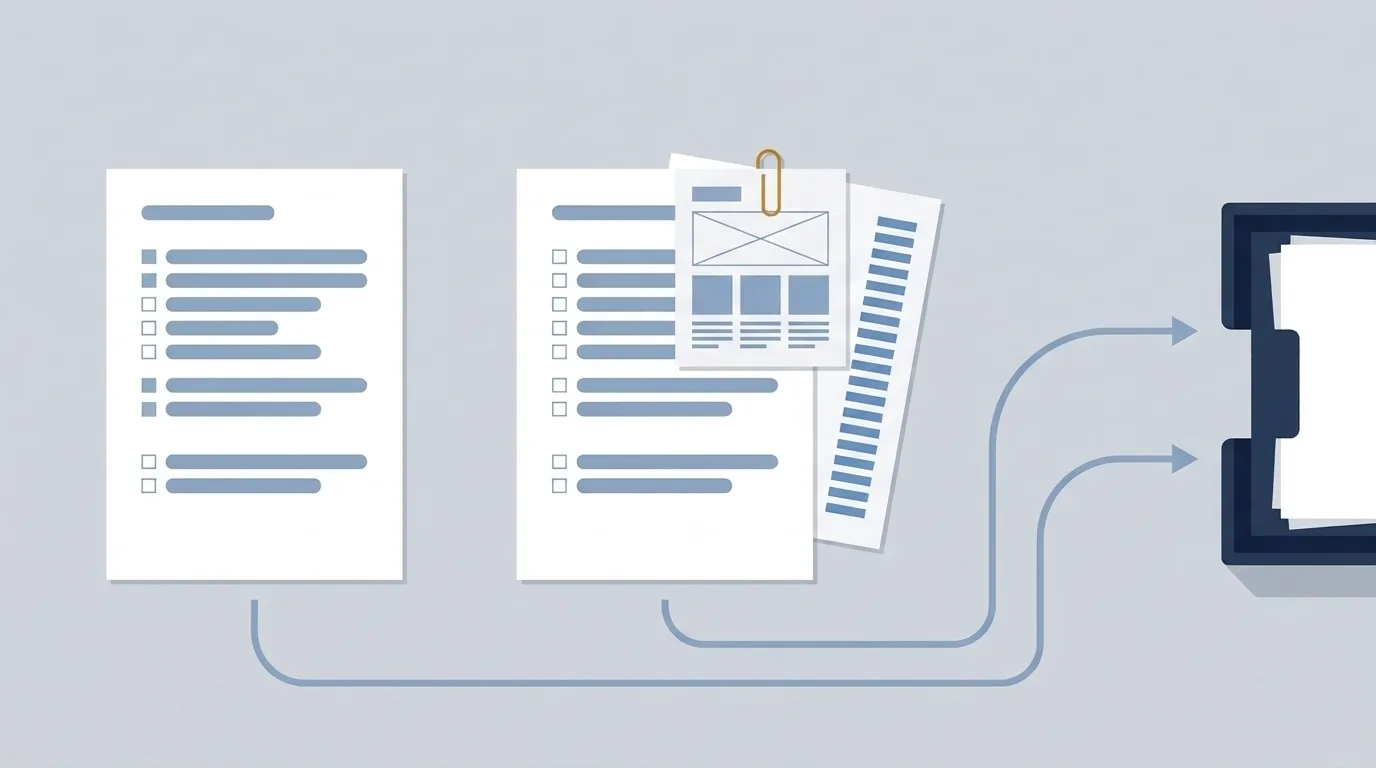
When you write the request, separate what you have decided from what you have not.
[Decided]
・5 static pages (Home, Company Profile, Services, Careers, Contact) + news list and post detail
・One person in general affairs will update the news themselves (about twice a month)
・We will keep using the current domain
[Undecided / to discuss]
・Booking: We want to accept in-store bookings, but have not decided whether to take requests through a form or confirm from open slots. Whether to take advance payment is also undecided. Please explain the differences between these options
・Social media: We want to show Instagram, but would like to discuss whether a link is enough or posts should be displayed
・Photos: We want to decide whether to request a photo shoot after seeing the quote
In this format, the developer can quote the decided parts and give separate prices for the undecided parts, such as “Option A” and “Option B.” When you compare quotes, it is easier to line them up on the same conditions.
Before you write “leave it to you”
You can write “we’ll leave the design to you” or “we’ll leave the structure to you,” but developers find it hard to tell how much you are actually leaving to them. Even when you leave it to them, adding a few pointers, such as “there are two sites we’d like to use as references” or “we want the colors to match our company logo,” will make the proposals more consistent. For a full list of what to prepare, see What to Prepare for Website Development: A Client Checklist.
What to Check Before Sending
- If you used any of the 7 terms in the table, does that line include what it covers, who handles it, and the quantity or frequency, as far as each applies?
- Did you split the page count into static pages and the post list, post detail, and number of initial posts?
- Did you include your preferred quote reply date and the cost breakdown you want (initial build cost, external service fees, maintenance fees)?
- Are the undecided items listed separately under “undecided / to discuss”?
- Will you send the same text to every company you ask for a quote? (If the conditions differ, you cannot compare the quotes.)
If you are still looking for a developer, see our website development services.







