
When building a website, many people get stuck when the web production company asks, “What would you like to do about the privacy policy page?” “We don’t sell anything, so we don’t need one, right?” “Can’t we just borrow the text from another site?” “Isn’t it the same as the Specified Commercial Transactions Act disclosure?” These are all questions we often hear in our production meetings.
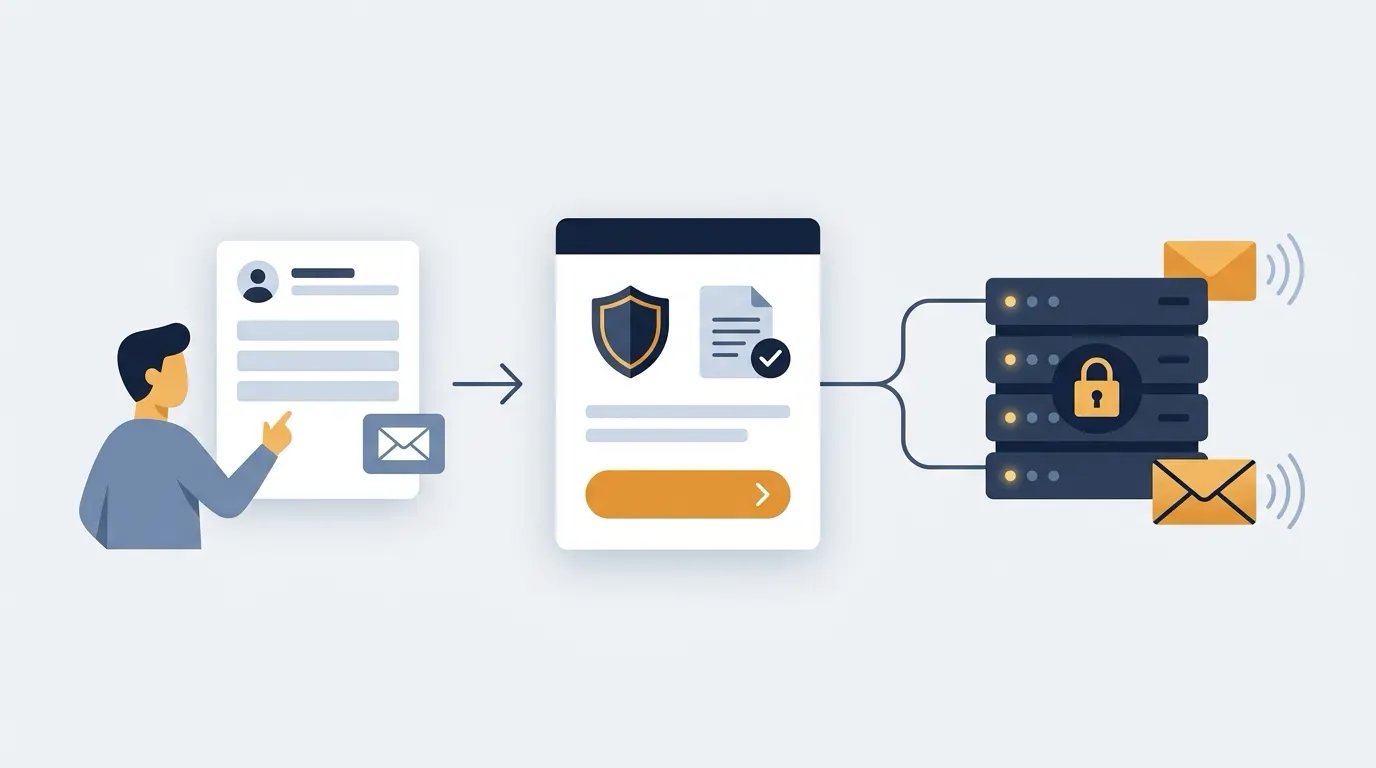
Once you place a contact form on your website, it becomes a point of contact that receives customers’ names and email addresses. Having received that information, you need to show people what you will use it for and how you will handle it. That is the role of a privacy policy. The disclosure under the Act on Specified Commercial Transactions, on the other hand, is a separate notice required when you sell goods or services online, and both its purpose and its contents are different.
This article explains why a privacy policy becomes necessary, the items to include, how it differs from the Specified Commercial Transactions Act disclosure, common mistakes, and where to place the links. Please note that we are a web production company, not legal professionals. What we cover here is limited to information that helps clients make decisions when consulting with their web production company.
For a website with a contact form, the principle is to show people what their personal information will be used for before they enter it. As the place to do that, the basic approach is to create a privacy policy page and link to it from the footer and from right next to the form. The main contents are the information collected, purposes of use, provision to third parties, outsourcing, security control measures, the contact point for requests such as disclosure, the use of cookies and web analytics, and how revisions are handled. The Specified Commercial Transactions Act disclosure is something separately required if you sell online, and it does not substitute for a privacy policy. Avoid copying another company’s text as is, and write it to match how your company actually operates.
Why a Contact Form Makes It Necessary
The Act on the Protection of Personal Information requires you to show people the “purpose of use”
The Act on the Protection of Personal Information sets rules for businesses that acquire personal information. At its core is deciding what the personal information will be used for (the purpose of use) and making it known to the individual.
Under the guidelines of the Personal Information Protection Commission, when individuals enter their own information into an input form on a website, it is treated as acquiring information directly from the individual in writing or a similar form. In this case, you are in principle required to clearly indicate the purpose of use to the individual before acquiring it. There is an exception when the purpose is obvious from the circumstances of acquisition, but to prevent misunderstanding, if you have a form, the safe approach is to make sure “people can see what the information will be used for before they submit it.”
Note that the text of the law does not say “create a page called a privacy policy.” What is required is showing the individual the purpose of use and other matters, and many companies use a privacy policy page as the means of doing so. With a single page, you can present the same content from the form and from any other page.
The difference between “publicizing,” “notifying,” and “clearly indicating”
The Personal Information Protection Commission’s materials distinguish between several terms for the ways of showing information to people. As a client, these are the three to understand.
| Term | Meaning | Example on a website |
|---|---|---|
| Publicizing | Making it known to the general public | Posting a privacy policy page on the site |
| Notifying | Informing the individual directly | Stating the purpose of use in the auto-reply email sent after submission |
| Clearly indicating | Showing it plainly to the individual | Placing the purpose of use or a link to the policy near the form’s submit button |
In situations like a contact form, where individuals enter and submit information themselves, it is important not just to post the page but to make sure the content is visible from, or easily reachable from, where they enter their information. The specific methods are explained later in “Where to Place the Links.”
Small businesses are covered too
Some people think, “Isn’t this about companies holding thousands of records of personal information?” However, the current Act on the Protection of Personal Information broadly covers businesses that use personal information in their operations, regardless of how many records they handle. Sole proprietors are no exception. Even if you receive only a few inquiries a month, the names and email addresses you receive are personal information.
Main Items to Include in a Privacy Policy
From here, we go through the items commonly included on a typical company website with a contact form. Note that the required items vary by industry and by the kind of information handled, so this is not a list where “these items alone are enough.”
Business name, address, and representative
This shows who handles the information. Write the company name, address, and the representative’s name. The Personal Information Protection Commission lists the business’s name and address, and for a corporation the representative’s name, as matters that must be made available for the individual to know.
Information collected
Write the items you receive through the contact form (name, company name, email address, phone number, inquiry details, and so on). Make sure they do not conflict with the form’s input fields. A common discrepancy is adding a phone number field to the form while the policy does not mention phone numbers.
Purposes of use
This is the most important item. Write the purposes you will actually use the information for, specifically, such as “to respond to your inquiry,” “to send quotes and materials,” or “to inform you about our services.” A vague phrase like “for our business activities” does not tell people what the information will be used for.
Be careful if you later want to send email newsletters or announcements about new services. Using the information in a way unrelated to the purposes you originally stated in principle requires the individual’s consent. If there is any chance you will send such announcements, state that purpose from the start.
Provision to third parties
State that you will not give the personal information you receive to other companies without the individual’s consent. It is common to also note that there are exceptions permitted by law (such as cases based on laws and regulations).
Outsourcing of operations
This is an area of frequent misunderstanding. For example, using an external service to manage inquiries or entrusting shipping to a contractor is treated as “outsourcing,” not provision to third parties. When you outsource, your company retains responsibility for properly supervising the contractor. If you may outsource, state that you do.
Security control measures
Show what measures you take to prevent the information you receive from leaking or being lost. The amended Act enacted in 2020 and in force from April 2022 added the security control measures taken to the matters that must be made available for the individual to know. That said, publishing detailed security procedures can actually give attackers clues. It is common to write an overview, such as “we limit the staff in charge” or “we manage who has access.”
Contact point for requests such as disclosure, correction, and suspension of use
Individuals have the right to request disclosure, correction, suspension of use, and so on regarding their own information. Write the contact point (department in charge, email address or phone number) and the procedure for making requests. Putting the contact for complaints here as well keeps individuals from getting lost.
Use of cookies and web analytics
On sites with web analytics tools (such as Google Analytics) installed, records of visitors’ browsing are sent to an external service. State that you use the tool, that you use cookies, and that cookies can be disabled in browser settings. The same applies if you have tags for ad delivery or ad performance measurement.
How revisions are handled, and the dates of establishment and revision
State that the content may change and how you will announce changes. In addition, be sure to include the date of establishment and the date of last revision. Without dates, no one can tell as of when the content applies.

How It Differs from the Specified Commercial Transactions Act Disclosure
The purpose and the people it protects are different
Because it is often placed alongside the privacy policy in the footer, the two are easily confused, but the disclosure under the Act on Specified Commercial Transactions is something entirely different.
| Privacy policy | Specified Commercial Transactions Act disclosure | |
|---|---|---|
| Legal basis | Act on the Protection of Personal Information | Act on Specified Commercial Transactions |
| Purpose | Shows how received personal information is handled | Shows the terms of mail-order sales and who the seller is |
| When it is needed | When you receive personal information through a contact form or similar | When you sell goods or services online (conduct mail-order sales) |
| Main contents | Purposes of use, provision to third parties, outsourcing, contact point for requests, etc. | Sales price, shipping fees, payment method and timing, delivery timing, return conditions, business name, address, phone number, etc. |
| Competent authority | Personal Information Protection Commission | Consumer Affairs Agency |
When is the Specified Commercial Transactions Act disclosure required?
If you accept orders and sell on your website, that counts as mail-order sales, and you need to display the terms of the transaction and other matters in your advertising. This of course includes online shops, but online courses and paid consultation services that accept applications and payments through the site can also be covered.
Conversely, a site that only has a company introduction and a contact form, and does not sell or accept applications on the site, usually does not count as mail-order sales. However, cases where something is called an “inquiry” but in practice prices are shown and applications are accepted can go either way. The safe approach is to confirm in advance, during production meetings, whether you will accept applications for goods or services — via the site, email, phone, or otherwise — from people who saw what is displayed on the site (this is not determined solely by whether payment takes place on the site).
We discuss whether to run your own online shop in “Should Your Company Have Its Own Online Shop?” If you start selling, assume you will need both a privacy policy and a Specified Commercial Transactions Act disclosure.
The 2021 amendment to the Act on Specified Commercial Transactions (in force from June 2022) made it a requirement to display, on the screen just before an online order is finalized (the final confirmation screen), matters such as quantity and price, the timing and method of payment and delivery, matters concerning withdrawal or cancellation of the application, and the application period if there is a deadline. The background was trouble caused by confusing displays for subscription purchases. When choosing an online shop system, also check that it can build this screen correctly.
Publicizing external transmission is yet another matter
One more point: the amendment to the Telecommunications Business Act that took effect in 2023 introduced a system (the external transmission rules) requiring the content of tags and similar elements that send user information externally to be publicized. It applies to businesses engaged in certain types of business, and not every company introduction site is covered. Sites run as membership services or as information-providing media, for example, may be covered, so if this seems likely to apply to you, check the guidance from the Ministry of Internal Affairs and Communications or consult an expert. Some of the content overlaps with the cookie section of a privacy policy, but it is treated as a separate system.
Common Mistakes
Copying another company’s privacy policy as is
This is the most common mistake. Another company’s text contains purposes of use and contractors tailored to that company’s business. If you copy it, you may end up listing purposes you don’t actually have, or missing purposes you really do use the information for. In addition, copying in full, without permission, text that another company spent time creating can itself be a problem. Even when using a template for reference, the premise is rewriting each item one by one to match how your company actually operates. There is no guarantee that simply filling in a template makes it legally sufficient.
What is written differs from actual practice
The policy says “we do not provide information to third parties,” while in reality inquiry details are shared with an outside sales agency. It says “we do not use web analytics,” while an analytics tag is installed. Such discrepancies often arise when the policy was correct at the time it was written, but tools or workflows changed later. Review whether what the policy says matches actual operations about once a year.
No establishment or revision dates, or not updated
A policy without dates gives no indication of when its content applies. It is also common to see the form fields or tools change while the policy stays as it was years ago. When you fix the form, fix the policy too. Making a habit of treating the two as a pair makes discrepancies less likely.
The contact address doesn’t actually receive messages
There are cases where the email address for the request contact point is still the personal address of a staff member who has left. If requests such as disclosure don’t arrive, there is no point in listing a contact point. How to check when emails from the contact form itself don’t arrive is covered in “Why Contact Form Emails Don’t Arrive and How to Fix It.”
Where to Place the Links
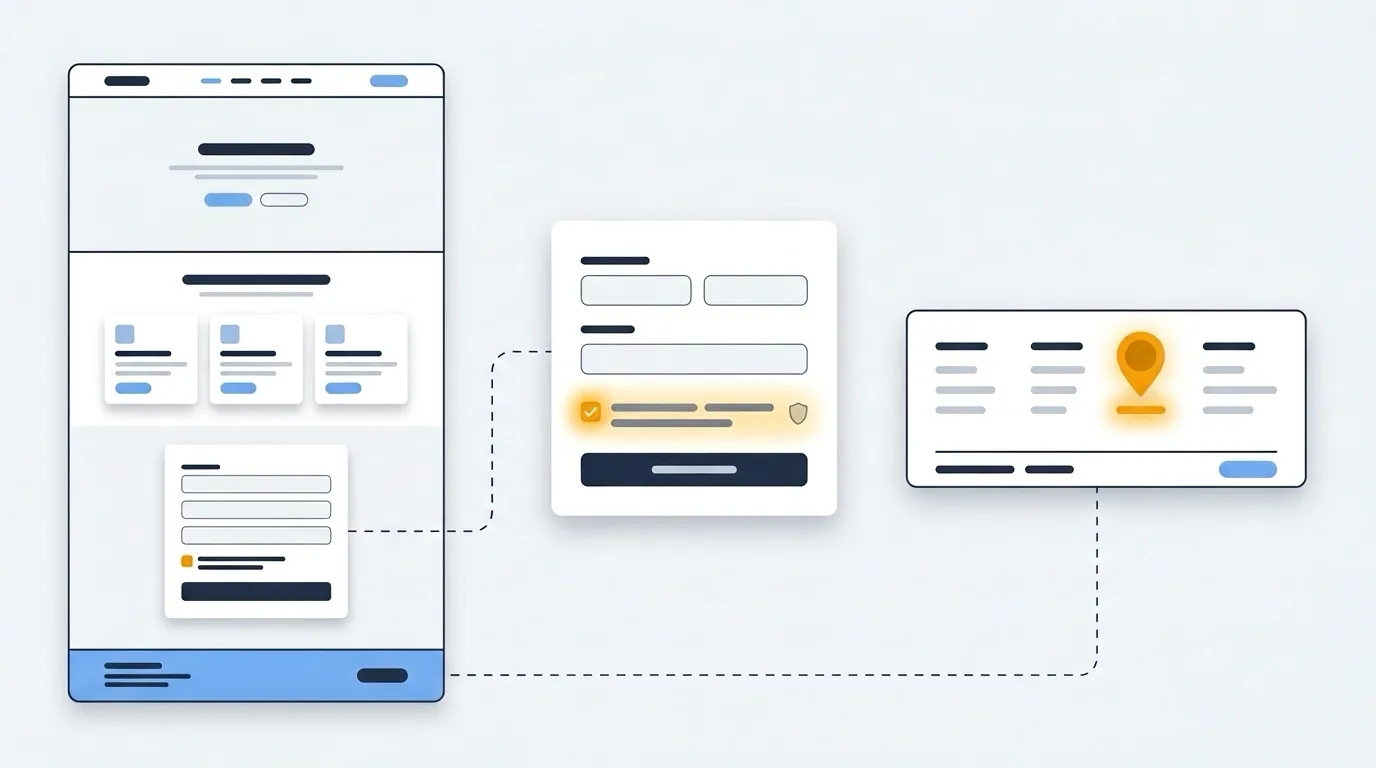
Place it in the footer, common to all pages
First, place a link to the privacy policy in the site-wide footer (the very bottom of the page). What matters is that it can be reached from any page. On sites that require a Specified Commercial Transactions Act disclosure, it is common to place that link next to it.
Place it right next to the form as well
The footer alone may not catch the eye of someone filling in the form. For a contact form, the basic approach is to write “Please review our privacy policy before submitting” just before the submit button and place a link to the policy there. Another option is to add a consent checkbox. Whether to make the checkbox mandatory depends on the information handled and the purposes of use, so decide in consultation with your web production company.
Setting the link to open in a new tab prevents what has been entered so far from being lost. If the page switches in the middle of filling in the form and the entered content disappears, people may simply leave. How to build the form as a whole is explained in detail in “How to Create a Contact Form.”
When You Should Consult an Expert
For a small company website that only receives inquiries, a privacy policy can often be put together by accurately writing out how things actually work. On the other hand, in the following cases we recommend consulting a lawyer or another expert familiar with personal information and consumer transactions.
- You receive information that requires particularly careful handling, such as health conditions or medical history (medical care, nursing care, counseling, etc.)
- You have membership registration or booking functions and continuously accumulate a large amount of personal information
- You share received information with group companies or partners, or store it on overseas services
- You start selling online (which also involves the Specified Commercial Transactions Act disclosure and drafting terms of use)
- You cannot determine whether you are covered by the external transmission rules
When we build a website, we provide a list of “what the site does as a system,” such as the form’s input fields, the analytics tools used, and the flow of emails after submission. Finalizing the policy text is up to the client or an expert, but having this list makes it easier to prevent statements that differ from actual practice. If you want to sort out what to request and to what extent in your production contract, also see “7 Places to Always Check in a Website Production Contract.”
Summary: Decide on the Policy When You Build the Form
A privacy policy tends to be seen as “a page you just put up for now” right before a website is finished. In reality, though, it is the very work of deciding what you receive through the form, what you use it for, and who handles it. If you decide the purposes of use and handling at the same time as the form’s input fields, you can write a policy without discrepancies.
- If you have a contact form, show people the purpose of use before they enter their information
- The items to include are information collected, purposes of use, provision to third parties, outsourcing, security control, contact point for requests, cookies, and revisions
- The Specified Commercial Transactions Act disclosure is separately required when you sell online
- Don’t copy other companies’ policies; include establishment and revision dates, and update the policy when operations change
- Place links in two locations: the footer and near the form
When building a new website or renewing an existing one, we help prepare the privacy policy page along with the form design. You are welcome to consult us even at the stage of “we’re not sure whether our current site’s policy matches how we actually operate.” For details on our production services and fees, please see our “Website Production” page.







